Twenty-one years ago, seven elections ago, the student loan scheme was at the sharp end of the election debate. Labour proposed going interest free. National said that was irresponsible. Labour won, their vote strengthened by legions of parents and grandparents who feared what they saw as the corrosive effects of debt on young family members, who feared their children/grandchildren would succumb to the lure of overseas, who wanted to encourage young people to stay in New Zealand.
Seven elections later, Labour and National are at it again – arguing about graduate debt.
Neither is proposing anything much for the tertiary education system – leaving it to their potential coalition partners to come up with possible changes to the system. In 2026, the action centres on graduate debt, on which party has the plan to ease the burden on graduates.
In this post, I explain the differences between the two proposals, their strengths and (mostly) their weaknesses ….
The proposals
Student support – like any financial support intervention – will always have complicated operational rules. But my focus here is on the principles and the costs, rather than the finer detail.
National intends to:
- Reduce the repayment obligation – from 12 cents per dollar of income over the threshold[1] to 10 cents per dollar
- Increase the interest rate on loans held by those living overseas and tighten up enforcement of repayment from those overseas-based loan holders.
Labour intends to:
- Write off 10% of a loan holder’s balance once he/she has remained in New Zealand for three years (provided the person hasn’t had the benefit of a year’s fees-free under the now-abandoned fees-free policy)
- Write off loan balances entirely if they are $2,000 or less for loan holders who have remained for three years in New Zealand.
So neither policy affects what happens in borrowers’ education – rather, these proposals are both about the management of the debt after the loan holders leave study.
Both affect the time taken to repay the loan – National’s policy proposal will increase the repayment time, while Labour will reduce the time to repay. Both will cost, but the costing of long-term financial instruments is very, very complex so neither has been costed rigorously.
This comparison looks at the effects on time to repay.
Repayment time comparison
The Labour website cites three cases.
- Tom completes a nursing degree with a student loan of $40,000 and enters the nursing workforce.
- Mia gains a medical degree with a student loan of $120,000 and starts work as a house officer
- Aroha graduates with a teaching degree and a loan of around $40,000. She begins teaching.
Let’s use these three illustrative cases as a starting point. Let’s suppose they all meet the conditions of the Labour policy – no fees free and remain in New Zealand for their three years post-graduation. I have modelled what happens to their repayment times under the two rival policy proposals. But rather than use the made-up salary figures on the Labour website, I have used actual salary scales and made an allowance for modest wage inflation over the term. The three hypothetical cases used in the Labour party material are all of professionals entering high-paid professions, with stepped annual increments in salary and supported by powerful trade unions. As a contrast, I have added a fourth case, someone who leaves study with a loan of $30k, takes on retail work at a salary of $50k and whose salary rises at just above the rate of wage inflation.
Table 1 gives the result:
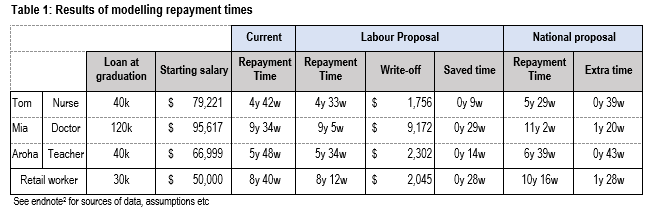
Table 2 gives the percentage change in time to repay, and, in the case of the Labour proposal, the percentage of the graduating loan actually paid off – which is 10% of the loan balance three years after leaving study.
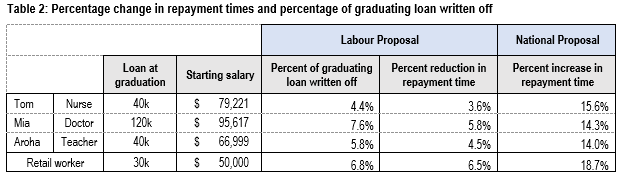
The percentage of graduating loan written off under the Labour proposal – 10% of the balance outstanding after the three years – depends on how much of the loan is repaid in those first three years.
The repayment time savings made under the Labour proposal is sensitive to the salary rate and also to the size of the loan; while Tom and Aroha have the same loan size, Tom’s higher salary, means he gets a lower write-off and the time saved in repayment is shorter. But if Tom’s graduating loan was $70k, his repayment time would be 7 years and 28 weeks under the current rules, but only 7 years and 5 weeks years – a reduction of 5.9% – under the Labour proposal.
The additional repayment time resulting from the National proposal is sensitive to both the size of the loan and also the salary level. Those whose repayment time is extended most by the National proposal are Mia (with her very high loan on graduation and her very high earnings) and the retail worker whose earnings are low and increase only very slowly.
The Labour proposal
Labour’s release correctly noted that the effects of their change for an individual “… will depend on individual salaries, pay progression, loan balances …” And the party states that each of the three borrowers would “… finish repaying [her/his] loan sooner and keep more of [her/his] salary …”
It would have been useful for potential voters to realise that, in none of the cases mentioned in the website material was the repayment time reduced by as much as 7%, and none by as much as a year. It might have been helpful had the party been explicit that the sum written off was 10% of the loan balance at the point when the borrower becomes eligible.
Labour is explicit that the write-off applies only to those who remain in New Zealand during those three years post completion. However, that would be unlikely to make any significant difference to graduate emigration rates. That is because, in a great many cases, young people are better placed to get a job overseas once their NZ qualification is complemented by a few years in the workforce – which fits well with the three-year qualifying period for the write-off.
The National proposals
Reducing the repayment obligation will extend repayment times. The deduction from the pay-packet will be less. Announcing the policy, National implied those with loans will have a bit extra in their take home pay. Sounds logical. But … is it?
… just remember that, if National leads the next government, if National reduces the repayment obligation, they will also be wanting to introduce their new retirement savings policy. Meaning from 1 April 2028, compulsory KiwiSaver contributions rise from 3.5 cents per dollar of gross income to 6 cents per dollar[3]. Just one year after the repayment obligation reduces by 2 cents per dollar of gross income over the repayment threshold.
So if you are earning $100k pa, your annual loan repayment obligation reduces by $1,503 (ie, 2 cents in the dollar on $100k less my estimate of the repayment threshold in 2028). But your KiwiSaver contribution increases by $2,500. In ready cash, you are worse off by $997 a year or $19.18 a week. In other words, the reduced student loan repayment obligation partly offsets the KiwiSaver increase.
National has put forward the KiwiSaver and loan policies in conjunction because they are concerned about effective marginal tax rates …. If you earn between $78,000 and $180,000, your marginal income tax rate is 33 c/$. Under current settings, if you add KiwiSaver and a student loan obligation, the effective rate is 33 + 3.5 + 12 = 48.5 c/$ which means that you get to take home 51.5 cents of the next dollar you earn. An effective marginal tax rate of 48.5%. Without the change in the repayment obligation, the effective marginal tax would be 33 + 6 + 12 = 51% once KiwiSaver rises to 6 c/$. Dropping the repayment obligation to 10 c/$ over the threshold keeps the effective marginal tax rate to 49%. A whisker under the psychological danger zone of 50%+.
In other words, the National policy really amounts to a transfer from (interest-free) loan repayments to (interest bearing) retirement savings. That is probably a wise investment for most people …
Costs
As for costs …
Loans have two forms of cost. The loan scheme cost of lending is technically called the “initial fair-value write down”. It reflects the facts that:
- the government pays interest on the loans it takes to get the cash to lend to students
- the value of the loans it makes is eroded by inflation
- some borrowers never repay …
among other things.
And there no interest is charged to most borrowers, so there is no revenue stream to offset those costs. The initial fair value write-down rate is determined by independent actuaries. It is sensitive the state of the labour market (which affects graduate employment rates and earnings and hence, repayment times), to international financial movements (which influence the government’s borrowing costs) and to cost inflation and wage inflation. The actuaries model all those factors and make assumptions about borrowers’ behaviour – for instance, the likelihood of emigration, loan enforcement practices …. Many of these factors are beyond the influence of policy. The valuation comes up with the initial fair value write-down on the lending, a figure that, in most years, has hovered around 40 cents per dollar lent; in other words, it costs the government around 40 cents in most years to lend a dollar.
And in addition to the costs of new lending, there may be a capital cost, which is the reduction of the value of the stock of historic loans – that is an asset that is held on the government’s balance sheet. Over the last decade, the value of the loan scheme asset on the government’s balance sheet has been 61% of the face value of the loans.
If a policy change affects existing loans, that will affect the balance sheet value of that stock of loans. When a new policy takes effect, the actuaries will also determine if there is any effect on the asset value[4].
Both parties’ policies will cost.
Labour’s policy will increase the cost of new lending as the government will get less back on each loan. It will also devalue the existing loan asset, because some of that historic lending will be written off.
The party’s website confidently predicts that their scheme will cost $40m a year once fully operational in 2031. Without sophisticated actuarial modelling, it’s not possible to estimate how much the write-down would increase as a result of this policy. But it will certainly lower the value of loans so it will increase the cost of lending. Working from the discussion on the Labour website and from loan scheme annual report data, my best guess is that their costing envisages the average size of the qualifying loan at the end of three years will be around $16k to $17k …. meaning an average write-off of between $1,600 and $1,700 and a fair value cost of around $1,000.
National has published a plausible costing. The reduction in repayment obligation – will stretch time to repay. That will increase the cost of lending. The shift from 10 c/$ to 12 c/$ in April 2013 saw a short-term reduction in the cost of lending (but the cost soon rose again – driven by a range of other factors). In reversing the 2013 change, the government recovers the same amount in repayments but over a longer time, meaning there is a loss in value. The biggest cost (nearly $300 million) is in the one-off write down of the value of existing loans. Thereafter, the cost is expected be between $20 million and $50 million a year.
The intention to clamp down on overseas-based loan holders should, if successful, offset some of that cost. Those overseas want to be able to return to NZ for weddings, funerals, family events. They don’t want to be arraigned at the border. So increasing the frequency of arrests at the border will encourage compliance. Nor will they want their credit history in Australia or the UK tainted by having to engage with the commercial debt collection companies contracted by the government to recover the loan, so the party’s plan to increase the use of commercial debt collectors will create a further incentive for overseas-based loan holders to comply. They expect to raise around $16.5 million a year from the changes to overseas-based loan holders, offsetting the estimated cost of the annual ongoing cost of the repayment obligation change.
… which raises another point about election promises
It is simply not possible for political parties – especially opposition parties – to do realistic accurate costings of significant student loan policies. And officials who have the knowledge and skills, and the access to the data needed for high-quality policy costing are neutral and therefore, not permitted to critique or comment on (let alone analyse or cost) parties’ proposals. Reinforcing the need – now accepted by both cornerstone parties – for an independent policy costing unit to provide objective information to voters.
A footnote, a personal anecdote
While 2026 sees a difference between the two cornerstone parties on dealing with student loans, this is not a student loan election. Unlike 2005. That was the student loan election.
Student loans have always been, always will be, controversial[5].
But never more so than in the first years of this century in New Zealand. A select committee inquiry in 2001 had criticised policy settings and the administration of the scheme. One student leader urged students to emigrate to avoid repaying. Demographers blamed the loan scheme for falling birth rates. An Auditor-General’s review criticised the management of the scheme and the quality of accountability information. NZUSA lodged a complaint with the Human Rights Commission, arguing that the scheme discriminated against women. The minister was overloaded with letters from parents and grandparents complaining their children were being driven overseas by student loans.
All despite the fact that loans for tertiary study are an equitable means of sharing the costs of study between the student (who stands to benefit personally from study) and the government (representing the public benefit from the study). Despite the fact that the loans were income-contingent – so that repayments were made only when the borrower earned enough.
By 2005, many of the problems raised by the select committee and the Auditor General had been addressed. The agencies had improved their management of the scheme, they were linking data on individuals’ tertiary education, their borrowing and their repayments, which led to better costing, more robust policy analysis and better accountability. The myth of the effect of student debt on home ownership and on willingness to have children were being challenged. The allegation of discrimination against women was found to be questionable ….
Yet the public remained unconvinced.
That was the context for the Labour 2005 proposal to remove all interest for nearly all borrowers. That policy probably wouldn’t have shifted young people’s votes, but it would have found favour with parents and grandparents.
The legislation was presented to parliament as a technical measure, a finance bill, not a social policy measure, not an education matter. At the Finance and Expenditure Committee, the debate was largely focused on expected costs. Until one member, ACT leader Rodney Hide, asked the one really important question: “What are the distribution effects?” The Inland Revenue official appeared not to understand the question. The Treasury official was nonplussed. Relegated to the back row, I intervened to explain that we hadn’t had the opportunity yet to do the analysis but we expected it was regressive.
In the third reading of the Bill, in the Committee of the Whole House, National argued this was bad policy, until Darren Hughes, Junior Government Whip gave his short but memorable speech: “We won. You lost. Suck it up!” Having argued against the Bill during the debate, NZ First, the government’s coalition partner, duly voted to support the measure.
Two years later, the Australian economist Bruce Chapman, architect of the Australian HECS scheme on which the design of the New Zealand student loan is based, told me that fellow economists had criticised HECS because the inflation rate is used as the interest rate for student loan debt[6]; he said that most economists argued that the design New Zealand scheme – which had a market-linked interest rate – was superior.
His argument in defence of HECS was that, what was “right” in a pure economic sense wasn’t all that mattered in social policy; what is equally important is the political economy. He suggested to me that, had the original design of the NZ scheme used an inflation measure as an interest proxy (rather than a market-linked rate), we wouldn’t have faced the level of enduring public opposition that had characterised the first decade of the scheme. His view was that, had we followed the Australian (ie, his) approach, we wouldn’t have been forced into an interest-free scheme …
More than anything else, interest-free loans delivered settlement. Settlement of a decade long dispute. The technical problems were resolved, the administration improved. The acrimonious debate eased. But what led to public acceptance was the interest free policy. The 2026 debate is just a skirmish on the margins.
Endnotes
[1] The repayment threshold is currently $24,128 per annum
[2] A small allowance is made for wage inflation. This results in a modest annual increase in the repayment threshold. Salary scales for doctors, nurses nd teachers are as published by Health NZ and PPTA. Nurses are assumed to work for Health NZ. Salaries offered by other nurse employers are likely to be significantly lower. Doctors are assumed to work in Health NZ hospitals. The modelling assumption is that doctors spend three years as a house officer and then to progress to registrar. The doctors award allows for multiple additional payments (eg rural loading, on-call allowance etc). The figures used exclude all such allowances except the superannuation allowance of 6%. Doctors’ salary rates are counted for Run Category 3 (45-50 hours/week). Those on Run Categories A to D get paid at higher rates.
[3] Note that the government has already set the KiwiSaver rate to rise from 3.5 c/$ from 1 April 2028; National’s election policy is to up it to 6 c/$, instead of 4 c/$.
[4] This summarises information in the Student Loan Scheme annual report. The latest edition, for 2024/25, is here.
[5] See Hamlet Act 1, Scene 3 … a young Dane, Laertes, about to travel to France as an international student at the Sorbonne, is advised by his dad, Polonius, not to take out a student loan. Four centuries, 423 years, of opposition to loans for study. On the other hand, historian Yuval Noah Harari, in his history of the 200,000 years of humankind argues that one of the defining characteristics of successful hum societies is the willingness to extend credit and take on debt. Borrowing for study is a way of creating future wealth.
[6] They use the lower of Consumer Price Index and the Wage Price Index as the inflation measure.

