The University Advisory Group (UAG) has made a call for a third round of submissions. They are posing important questions …. But how does this this review stack up against other important tertiary education priorities?
The context … a system in change mode
Following the formation of the new government in 2023, the incoming minister moved quickly to set up a process to deal with the challenge of Te Pūkenga. That’s an enormous job, one that’s taken the best part of a year, with the second round of government decisions (on the shape of the new structure) due any day, if the rumour chain has it right.
And in the coalition agreement, the government committed to a change to the fees free policy – a highly complex matter, one that (as is well known) I have no sympathy with. I am sure that this, too, is absorbing lots of agency energy.
For the universities … the higher education funding review initiated by the previous government has been shelved in favour of a comprehensive strategic review of the universities, a counterpart to a review of the country’s innovation and research system.
Yet there was nothing for the troubled foundation education system. The universities review presumably has soaked up all the rest of the energy of the government tertiary education agencies. Is a strategic review of the universities really more important than rescuing a failing foundation sector?
So how urgent is a strategic review of the universities?
We all know that the government sees the education system as one of the keys to our future prosperity. The performance of the tertiary sector – and the higher education part of the sector – will play a big part in building our future . But what’s the baseline? How good or how poor is our university system? How do we stack up?
To get a sense of how well our universities perform and of the urgency of a strategic review of the system, it’s useful to compare the New Zealand system with university systems in other countries, other high-income OECD countries. And given the importance of population size and population density to research and innovation performance, we need to look at countries of a similar population. Let’s put NZ alongside Ireland and Finland.
Ireland represents a particularly important benchmark: an all but identical population, an Anglophone country (but with an indigenous language as second language). An island country adjacent to a large neighbour, with which it has freedom to travel and work. A country, like NZ, with eight universities[1].
Finland provides a somewhat different point of reference – a Scandinavian country with a very strong educational culture and, like Ireland, an EU member, with all the economic, educational and research advantages that brings. Finland has 13 universities (and 22 universities of applied sciences).
Total resourcing for institutions (from all sources, government and private) per EFTS in tertiary education in 2020 in New Zealand and Finland was almost identical, with Ireland slightly lower – 89% of the other two[2].
There were two differences in resourcing, however. The two European countries receive a very high proportion of their resourcing from government (Finland 90% and Ireland 70%) compared with New Zealand (58%). The second difference was in the share of institutional revenue that comes from research, with 44% attributable to research in Finland, 25% in Ireland, and 19% in New Zealand[3].
Table 1 summarises some of the indicators.
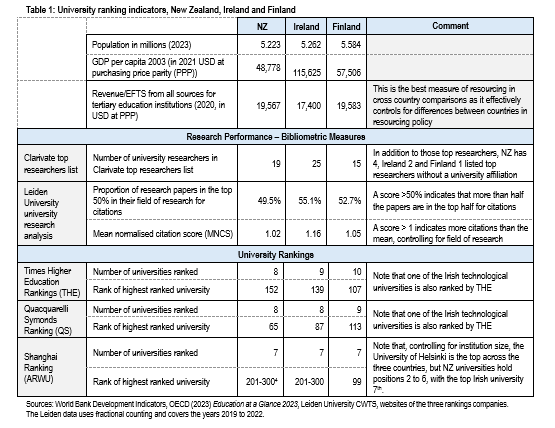
On those indicators, it is clear that Ireland outperforms the other two countries in research, with Finland outpointing New Zealand.
Table 1 focuses on only two bibliometric indicators (probably the most meaningful measures), but the same general pattern would be seen across a wider range of measures – NZ is OK in international terms (with NZ sitting pretty much right in the middle of the range of international expectations in the two measures). But NZ places third of these three small countries.
University rankings are less meaningful as measures – they are subject to all sorts of distortions that are well documented[5]. Nonetheless, the formulae used by the ranking companies provide some basis for comparison ….
Finland looks to hold a slight edge over the other two countries, but there is little to separate Ireland and NZ.
A close examination of the data suggests that one strength of the New Zealand system is that there is less variation in ranks than in the other two countries; there is less stratification in the NZ university system.
So did we really need a strategic review of the university system?
If the review aims to lift overall university performance, it may have been better, as well as simpler, to have continued the previous government’s funding review; on balance, the system performs reasonably well in international terms.
But …. if the goal was to lift performance in research, there are grounds for asking “how could we do better, how could we match Ireland?” That suggests that the underlying goal of the UAG has to have been “how can NZ get better research and innovation performance from the university system?”
Is a whole-of-system strategic review necessary? Should it have supplanted a look at the foundation sector? I leave it to you to judge ….
But the UAG is posing important questions ….
Whether you think the review is warranted or not, the UAG is (rightly) taking a whole-of-system approach, and asking important, searching questions, not just focusing on research. A shame, however, that they pose a dozen or so important questions and ask submitters to squash their responses, their views, into five pages!
My response to Round 3 is here …
Endnotes
[1] Noting however, that the network of technological institutes are going through a process of transitioning to technological universities – see this report. The longest established of the new technological universities – TU Dublin – is now ranked both in the QS and the THE rankings.
[2] OECD (2023) Education at a Glance 2023 Table C1.1
[3] OECD (2023) Tables C2.1 and C3.1
[4] While the highest ranked universities in Ireland and NZ are ranked in the same band by ARWU, the leading Irish university, Trinity College Dublin, scores higher than the leading NZ university, UA. However, looking at per capita performance in that ranking, the four main centre universities and the University of Waikato all exceed Trinity.
[5] See this article and this site for some of the common critique.
 Strategy, Policy, Analysis | Tertiary Education