What’s the problem?
It was back in 2004. In the wake of the first PBRF quality evaluation, universities were thinking about how to lift their research performance. One way was to get more research degree students. A PhD student is an apprentice researcher. Each student can lift a busy academic’s research output by researching in the supervisor’s research specialty area, under the supervisor’s direction, with the resulting thesis sparking two, perhaps three, perhaps even more, research publications that would count when the next PBRF quality assessment came round. Essentially, a good PhD student has the potential to lift the research productivity of academics – whose working day is otherwise liable to become bogged down by teaching, by assessing undergraduates, by contributing to a department’s extension work, by attending the countless meetings that oil a university’s bureaucracy.
Plus, a PhD thesis, once submitted and passed, adds to the university’s research degree completions score …
More PhD students would pay in research volume and, ultimately, quality. The argument went: that would benefit the national research enterprise, it would benefit New Zealand (as well as the institutions that enrolled the students).
The problem was … how could a small country with a small system and a small (if honourable) reputation, just three hours east of Sydney and Melbourne, …. How could we attract enough international research students to make up for the paltry numbers of local graduates willing to take on the life of a full-time PhD student. Sure, the universities paid moderately generous scholarships to their best local PhD students. But the real market was international, in competition with prestige universities in Australia, Canada and the UK, and with the seemingly bottomless research resources of the pre-Trump US.
The answer of course, was price. The level of fees charged to international students. The case was made. The tertiary education minister (Trevor Mallard) was persuaded. Cabinet was persuaded. A schedule to the Act was amended[1]. From 2005, international PhD students would attract a government subsidy, equal to the funding paid for a domestic enrolment. Fees for international students taking a PhD would fall – to equal domestic student fees. No caps or limits in those days of demand-driven funding. And when caps came back in 2009, there was no special limit for international PhD enrolments – international doctorate students were treated the same as domestic undergraduates.
The number of international PhD students grew steadily.
So … what is the problem?
The problem is the same as all government funding problems. Often, when a funding policy works as intended, that can be a problem; if it is really successful in delivering what it set out to do, it costs.
RNZ quoted Minister Penny Simmonds as saying that, in 2025, the cost of the scheme increased from $56 million to $69 million, an increase of 23% and that, as a result, the 2027 funding for international PhDs will be cut to $56 million.
In this paper …
In this paper, I will do a profile of international PhDs, look at the likely winners and losers among the universities from the funding reduction and look at trends in international research student enrolments in Australia – including the financial support for international PhD students in that country.
Profiling international PhD students …
Looking at enrolments …
The number of international students enrolled in a PhD has certainly increased – the 2025 headcount was up 14% on the previous year, 18% over the previous decade and 88% since 2010. In EFTS terms (which is a better reflection of the impact on funding), the 2025 figure was 16% above the previous year and up by 14% over the decade. The 2025 level – headcount and EFTS – was just above the previous high of 2019, before the pandemic sent the numbers down.
While EFTS rose 16% between 2024 and 2025, we noted above that the funding generated by those EFTS went up by a greater percentage, meaning that there was a shift from lower to higher cost fields of research.
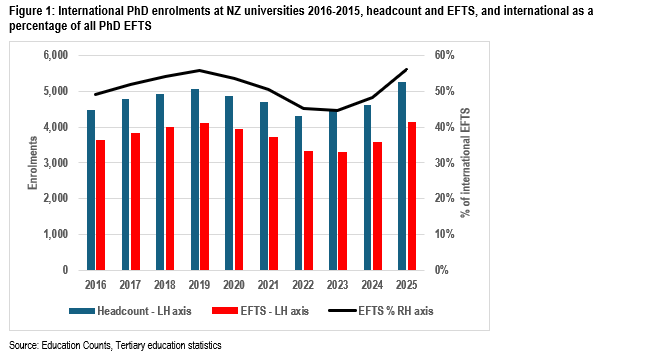
The proportion of PhD students who are international rose from around a third in 2010 to just over a half in 2025. International PhD EFTS reached 56% of total PhD EFTS in 2019, fell away in the years affected by the pandemic (2020-2024), and rose to 56% again in 2025.
All eight universities have had a heavy reliance on international EFTS.
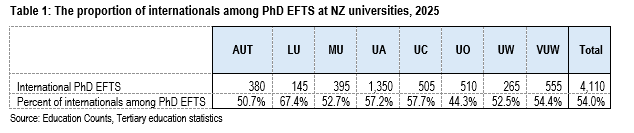
The three South Island universities plus Massey have seen international PhDs fall over the decade, with Massey, Lincoln and Otago all experiencing (small) reductions in total PhD enrolments.
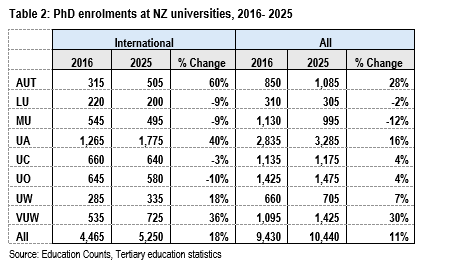
Certainly, without a good number of international PhDs, many university departments across the system would have had a thinner postgraduate programme and, presumably a thinner research culture. The policy set out to mitigate exactly that risk.
One of the markers of how the international PhD programme has worked relates to the region from which the international students have come.
While between two thirds and three-quarters of all the international PhD students are from Asian countries, the great majority of students from that region are studying at an undergraduate level. By contrast, while there are few African origin international students in our tertiary system, a high proportion of the African students – more than a third in most years – are taking a PhD.
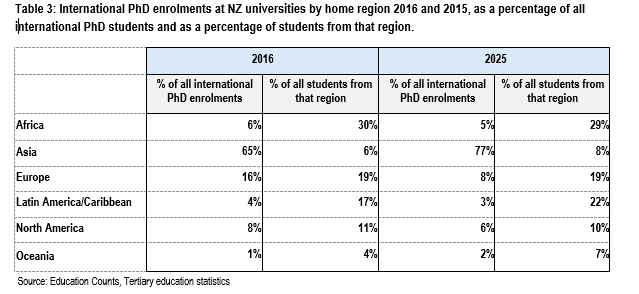
What Table 3 suggests is that students from Africa, Latin America, Europe and, to a lesser extent, North America have a reasonably high propensity to study in New Zealand in order to study at doctoral level. That indicates that the programme may have succeeded in drawing in PhD students.
May have ….
Looking at completions …
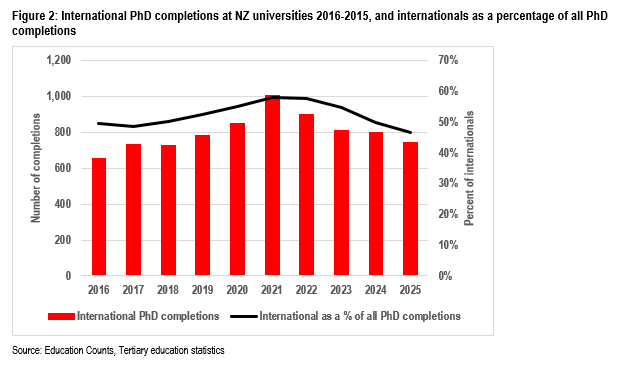
There has been a similar pattern in successful completions of PhDs. The lag in completion times means that the proportion of international PhD completions has yet to return to 50%, but, over much of the last decade, internationals have accounted for more than half of the total.
It’s also interesting to look at the field of research for the international doctoral graduates. Table 4 shows the proportion of internationals among the doctoral graduates in each broad field of research.
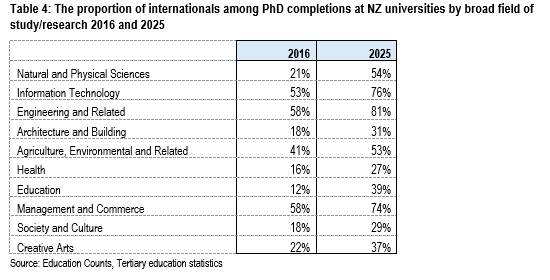
Table 4 suggests that sciences, IT, engineering, agriculture and commerce would be worst affected by a reduction of international enrolments in doctoral degrees.
Meanwhile, off to the west …
Government support for research enrolments
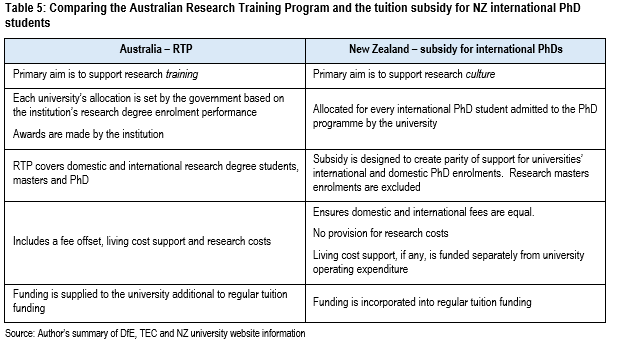
The Australian government more than matches New Zealand’s generosity towards international students[2]. There, the government provides funding to universities through the Research Training Program (RTP) to support their training of domestic and international students undertaking doctoral degrees and masters degrees by research – meeting fees and, in most cases, living costs and research costs. This is more generous to students than the current New Zealand arrangements.
The key differences between the Australian RTP and the New Zealand government’s subsidies for international PhDs are set out in Table 5.
Trends in research enrolments – Australia vs New Zealand
In the decade 2015 to 2024, research students – doctoral and research masters – at Australian universities increased by only 0.5%. Internationals grew by 33%, but domestic students fell by 15%[3].
Now, the Australian situation can’t be easily compared to the NZ case for two reasons: the first is that the Australian data covers research-based masters degrees as well as PhDs whereas the way data is categorised in New Zealand doesn’t allow us to distinguish research masters from other masters students. The second is that the 2025 Australian student statistics are yet to emerge (amazing but true), meaning we need to look at 2024, a year in which international enrolments had already substantially recovered from the pandemic in Australia, but when New Zealand’s international education was still emerging from the pandemic downturn.
Table 6 sets out some comparative data:
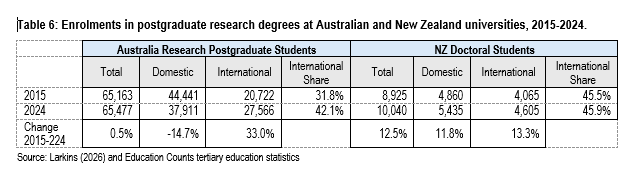
What is surprising and of concern to Frank Larkins (and, presumably, to other watchers of the Australian system), is that the majority of the Australian universities (22 of 40) had fewer research students enrolled in 2024 than in 2015. Despite the objective of RTP being research training. Despite the generous financial support. Despite the large number of very large, very high reputation universities.
The effects of a shift of funding away from international PhDs
Government funding – winners and losers …
So what would happen if there was a shift away from government funding for international PhD enrolments. Who would be the winners and losers….
If the government funding was removed entirely and abruptly, the three universities most affected – those with the highest dependence on the international PhD subsidy based on 2025 data – would be Lincoln and the Universities of Auckland and Canterbury, while Otago (where less than half the PhD EFTS load is international) would lose least.
All of the universities offer (and fund) PhD scholarships that meet students’ living costs. Some of those may be taken by international students at present.
However, reduced funding would likely be redistributed as a means of reducing the number of unfunded domestic EFTS across the system, softening the blow. It was this, presumably, that led to the Chair of Universities NZ, Neil Quigley, to tell RNZ that ”… there’s enrolment growth for domestic students across the country … we’re in a period where the income from these students [international PhDs] is not as big a concern …”
But what would happen?
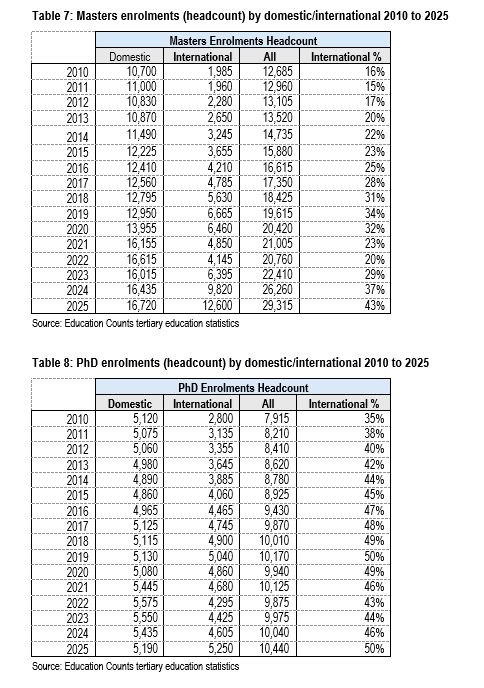
There is no counter factual. We have no easy way of telling just how price-elastic PhD enrolments are. So, we don’t know the effect of the loss of government funding. We don’t know if universities would revert to standard full-cost fee-setting[4]. And if so, what effect that would have on enrolments. It’s worth noting that international enrolments in masters degrees – whose fees are set on a full-cost recovery basis – have increased four-fold in the last decade (from less than 5,000 to nearly 20,000). And international students have gone from 16% of all masters enrolments in 2010, to 25% in 2016 and to 43% (and to half the total masters EFTS) in 2025 (see the appendix for the data).
Many international PhD students will be on university-funded doctoral scholarships that pay the student’s domestic fee as well as providing a reasonable living allowance[5]. So, it would be possible for enterprising universities to find ways of reducing the financial burden on international PhD students, and hence, reducing the loss of enrolments.
The research cost …
The important point here is that the purpose of enrolling international students in PhD degrees was never revenue. Rather, it was about building research culture, creating critical mass in research groups, providing additional research workers who could lift the productivity of a university’s best researchers (who, in many cases, have their energies diverted into teaching, assessing and institutional leadership tasks), contributing to major research projects … increasing research outputs and earning research degree completions.
But if the revenue lost were recycled into funding unfunded students …. So much the better.
It would be surprising if clever people in our universities weren’t already stepping out their dances.
Appendix – Further Data
Sources and references
Department for Education, Higher Education and International Education
Education Counts, tertiary education statistics
Gerritson J (2026) Cost blowout puts fees for foreign PhD students under review RNZ
Larkins F (2026) Research training programs at many Australian universities are experiencing major student reductions Frank Larkins
Norton A (2026) Mapping Australian higher education August 2026 update Higher Education Commentary from Carlton
NZ Legislation, Education and Training Act 2020 and Education (Domestic Student: Tertiary Education and Vocational Education and Training) Notice 2025
End notes
[1] See section 5 of this Schedule.
[2] The recent and growing hostility of the Australian government towards international students doesn’t extend to research students.
[3] The Australian analysis in this section comes from Frank Larkins’ recent paper on the issue Larkins (2026) Research training programs at many Australian universities are experiencing major reductions. Frank is a former DVC at the University of Melbourne and a fellow Melbourne Centre for the Study of Higher Education.
[4] Section 526(2)(a)(ii) of the Education And Training Act 2020 provides for setting fees at marginal, not average, costs.
[5] Refer for instance to this document and this.

